ORIC Program Overview and Benefits

The ARIS Organizational Research Impact Capacity (ORIC) Program helps universities and organizations build in-house skills, systems, and strategy to, assess and communicate research impact. ORIC is a two-year cohort experience that supports teams strengthen their Broader Impacts and scale effective impact practice across their institutions.

As the largest research impact community in the U.S., ARIS is a trusted partner for organizations seeking to deepen their expertise and better demonstrate the societal benefits of their research.

Institutions selected for an ORIC cohort join a national community of practice where Research Impact (RI) staff and administrators learn from one another, share effective strategies, and put new approaches into action. Any public or private organization that conducts or supports research and wants to strengthen and expand its current institutional capacity for Research Impact is welcome to apply.

ORIC cohorts learn about topics, including:

  • What is research impact?
  • Research communication;
  • BI fundamentals and writing effective BI plans;
  • Faculty development;
  • Building partnerships;
  • Funding models and sustainability; and
  • Impact resources.
Collage of ORIC members standing before colorful backgrounds

By participating in professional development, mentoring, and community-building — as well as using ARIS resources from — institutions that enhance the quality, visibility, and societal impact of their research. They also join an ORIC community of 40 institutions — as well as the larger ARIS societal impact community — which is continually evolving and expanding.

In addition, institutions can better show the benefits of research and how it connects with communities.

Institutions in the ORIC Community

Organizations in ORIC join a growing international community committed to building stronger systems for research impact, Broader Impacts, and institutional capacity. See the institutions that have participated in ORIC across recent cohorts.


University of Alabama
Baylor University
UC Berkeley
Binghamton University
University of California Merced
Fresno State
University of Chicago
Clemson University
Univ Of Colorado Boulder
Florida State University
University of Idaho
Indiana University at Bloomington
Massachusetts Institute of Technology
Michigan State University
University of Michigan
University of Minnesota
Mississippi State University
Montana State University
Mote Marine Laboratory
University of Nebraska Lincoln
University of Nevada Reno
University at Buffalo
University of North Carolina Wilmington
Northern Illinois University
University of Notre Dame
Ohio State University
Pennstate
University of Pittsburgh
Purdue
Stanford University
Texas State University
Texastech250
Texas A&M University
Texas A and M Corpus Christi
University of Texas at Austin
The University of Texas at El Paso (UTEP)
University of Toronto
Tulane University
University of Utah
Utah State University
University of Vermont
Virginia Institute of Marine Science (VIMS)
University of the Western Cape
University of Wyoming

2026 Participants | 2025 Participants | 2024 Participants | 2023 Participants | 2022 Participants | 2021 Participants | Pilot Participants

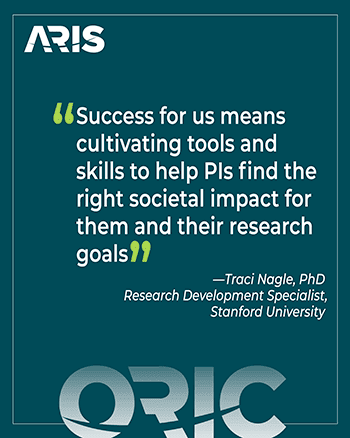
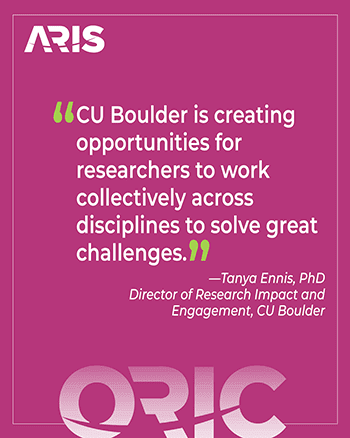
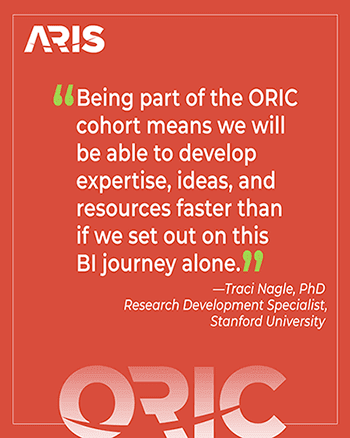
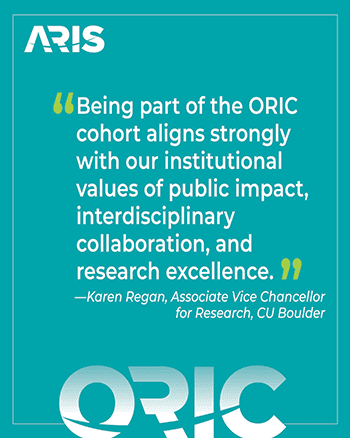
ORIC Participant Testimonials

ORIC Eligibility Requirements

Before applying to join an ARIS ORIC cohort, an organization must identify:

  • At least one administrative partner (i.e., typically a VP of Research, VP of Research Development, or VP for Community Engagement) who champions the institution’s RI professionals and actively advocates for institutionalizing RI infrastructure.
  • At least one in-house RI professional.

It is essential that the organization has these two components in place and is committed to strengthening and expanding its current Broader Impacts capacity.

ORIC Application Requirements

In addition to the online form, an organization’s application to join the ARIS ORIC cohort should include:

  • A two-page statement outlining the current landscape of RI support, the need for increased RI training and support, and a vision for how expanding RI training will advance the institution’s mission. A successful application should consider the perspective of institutional faculty/researchers and ways they may be incorporated into developing institutional infrastructure through the ORIC program.
  • A description of the RI professional’s qualifications and experience in RI support, highlighting their current strengths, areas of growth, and the skills/knowledge they hope to develop through ORIC participation.
  • A letter of support and commitment from the Administrative partner(s), affirming the institution’s buy-in and commitment to expanding the RI infrastructure. The letter should also include a commitment to fully participate in the ORIC program requirements.

If accepted to the two-year program, institutions must also agree to the requirements listed below.

ORIC Institutional Requirements

Upon acceptance to the two-year program, an organization must:

  • Participate in an intensive three-day, in-person training series designed.
  • Complete an organizational needs assessment and pre-landscape analysis before the in-person meeting.
  • Complete the ARIS BI Certification before the in-person meeting.
    • BI professional(s): Required. For ORIC participants, the BI Microcredential will be $1,250 per BI professional. This must be completed before the in-person meeting.
    • Administrative partners: Optional
  • Attend monthly meetings with ARIS leadership and subject matter experts.

    • Some meetings will be for RI professionals only, some for administrative partners only, and some for all participants together.
  • Present a poster on their organizational structure and action plan at the annual ARIS Summit.
  • Meet regularly as an internal team (i.e., RI professional(s) and administrative partner).
  • Fees (beginning with the 2027-2029 cohort):
    • Institutional participation fee: $5,000.
    • Emerging Research Institutions (institutions with established undergraduate or graduate programs and less than $50 million in federal research expenditures): $3,000.

      Institutions and ERIs must be an ARIS organizational member ($5,000 for institutions; $3,000 for ERIs) for every year it is an ORIC institution. There is a two year requirement.

ORIC Application Timeline

  • Applications open January.
  • Applications accepted January through February.
  • Selected institutions notified mid-March.

Sign up to receive ARIS’s email when the ORIC Call for Applications 2027 is open.

ORIC Call for Apps List – Inline

ORIC Program – Frequently Asked Questions

A: The ARIS Organizational Research Impact Capacity (ORIC) program is a two-year cohort that helps organizations build in-house knowledge, skills, and systems to understand, assess, and communicate the impact of their research. Through training, mentoring, and a community of practice, institutions strengthen their Broader Impacts (BI) work and expand their research capacity.

A: ORIC is designed for public or private organizations that conduct or support research and want to strengthen and expand their institutional capacity for research impact. Historical participants include universities, research institutes, funders, and other organizations that support or manage research programs.

A: There is no set limit; however, your team size must be clearly justified in your application. If you have questions about team size – or anything else – please email us.

A: Institutions gain professional development, mentoring, and access to ARIS resources that help them build and enhance internal systems for research impact. They join a national community of practice, improve the quality and visibility of their BI work, and are better positioned to demonstrate the societal benefits of their research.

A: ORIC cohorts learn about topics including:

  • What research impact is and why it matters
  • Research communication
  • BI fundamentals and writing effective BI plans
  • Faculty development
  • Building partnerships
  • Funding models and sustainability
  • Impact resources

A: Before applying, an organization must identify:

  • At least one administrative partner (typically a vice president for research, research development, or community engagement) who champions RI professionals and advocates for institutionalizing RI infrastructure.
  • At least one in-house research impact (RI) professional.

Both components must be in place, and the organization must be committed to strengthening and expanding its current Broader Impacts capacity.

A: Institutions accepted into the two-year program are expected to:

  • Participate in an intensive in-person training series led by ARIS.
  • Complete an organizational needs assessment and pre-landscape analysis.
  • Ensure BI professionals complete the ARIS BI certification.
    • Administrative partners are encouraged but not required.
  • Attend monthly meetings with ARIS leadership and subject matter experts (some for RI professionals, some for administrative partners, some together).
  • Present a poster on their organizational structure and action plan at the ARIS Summit.
  • Meet regularly as an internal team (RI professional(s) and administrative partner).

A: Beginning with the 2027-2029 cohort, selected institutions pay a $5,000 institutional participation fee. Emerging Research Institutions with established undergraduate or graduate programs and less than $50 million in federal research expenditures pay a reduced fee of $3,000.

  • You must be an ARIS organizational member for every year you are an ORIC institution. There is a two-year requirement.
  • BI professional(s) must complete the ARIS BI certification before the in-person meeting. For ORIC participants, the BI Microcredential will be $1,250 per BI professional.
    • Administrative partners: Optional
  • Additional fees for RI professionals and administrative partners (optional) who wish to become ARIS BI certified.

Selected institutions are also responsible for travel costs for their teams to attend the three-day intensive training session designed and led by ARIS in June.

Total cost for selected institutions are: $10,000 (includes organizational membership) + BI certification + travel for June training session.

Total cost for Emerging Research Institutions are: $6,000 (includes organizational membership) + BI certification + travel for June training session.

A: ORIC is officially a two-year program. During that time, institutions engage in cohort-based learning, attend the intensive training series, participate in monthly meetings, and implement an organizational action plan.

We find – and encourage – institutions to continue to engage with each other and ARIS for years after their two-year cohort timeframe is complete.

A: Applications accepted starting January, are due February, and selected institutions are notified mid-March.

A: You can sign up on the ORIC page to receive an email when the ORIC call for applications is released.

ARIS promotional banner with the ARIS logo, an illustration of stacked bricks and a cursor, and the text “Build campus BI/RI capacity. Shared language, practical tools, and better support systems.” A blue panel on the right reads “Customize your institutional training” with an arrow.
Interested in advertising with us? Email us for details.
Secret Link