
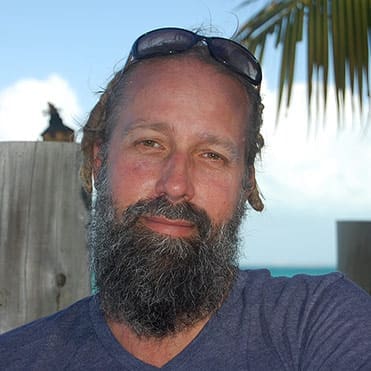
Kay Daniel Bidle, Ph.D.
Impact Innovations Award
Professor, Rutgers University
I like to think my dedication and leadership in the development and implementation of the ‘Tools of Science’ educational video series and its targeted use for students and teachers across the country has helped make a difference in communicating the importance, process and practice of science. It has served as both an infrastructure for a Broader Impact identity and an innovative, collaborative approach to benefiting society through research
I am a Professor at Rutgers University and molecular microbial oceanographer broadly defined. My research program focuses on microbial ecophysiology (especially phytoplankton), virus interactions/arms races, molecular evolution and ecology, carbon cycling, and ecosystem processes. My work has placed particular emphasis on how viruses impact Earth’s carbon cycling — it’s carbon heartbeat. I lead an NSF-funded Growing Convergence Research (GCR) — one of NSF’s Top10 ideas — project blending biology, chemistry, physics, engineering, applied math and modeling to assess how prevailing ocean conditions exert fundamental controls on the predictive outcomes. I have worked actively to develop resources for the broader scientific community for engaging, participating, and expanding in convergence-based research practices.
I want to acknowledge other important members of the ‘Tools of Science’ project team. It has been a sustained and close collaboration with colleagues at Rutgers including Janice McDonnell (Associate Dean of Research Impact) and Kim Thamatrakoln (Associate Professor and fellow microbial oceanographer), who have also been closely aligned with the goals and identifying core aspects of the Next Generation Science Standards (NGSS) to highlight through the active practice of our science. It has also been a result of the close partnership with collaborators at Tilapia Film, who are so uniquely talented at translating our science and presenting in tangible, accessible and impactful ways. ToS represents a wonderful example of how the art-science interface is extremely effective at enhancing the impact of research in society.