
Broader Impacts Definition
Broader Impacts (BI) often occur at the intersection of research and communities — especially when communities and researchers work together to identify relevant issues and work together to solve them. Communities may be within a neighborhood, town or region. It may affect 10s of people or millions of people.
When science connects with communities, we show why scientific research is important and how it affects people.
As the connection between research and communities is so important, many private and public funders have begun asking that proposals demonstrate societal benefit in addition to contributing to greater scientific knowledge. For many in the scientific community, this is a new way to think about their research and can require different partnerships and supports when writing proposals.
U.S. NSF Broader Impacts Definition
Specifically, in the United States, Broader Impacts are one of two merit review criteria that the U.S. National Science Foundation (NSF) requires. According to the NSF, Broader Impacts are the societal impact of the proposal and “may be accomplished through the research itself, through the activities that are directly related to specific research projects, or through activities that are supported by, but are complementary to the project.”
NSF grant reviewers evaluate broader impacts statement on five criteria:
- What is the potential for the proposed activity to benefit society or advance desired societal outcomes?
- To what extent do the proposed activities suggest and explore creative, original or potentially transformative concepts?
- Is the plan for carrying out the proposed activities well-reasoned, well-organized and based on sound rationale? Does the plan incorporate a mechanism to assess success?
- How well qualified is the individual, team or institution to conduct the proposed activities?
- Are there adequate resources available to the principal investigator (either at the home institution or through collaborations) to carry out the proposed activities?
Learn more by visiting NSF’s Broader Impacts page.

Broader Impacts Tips and Tools
NSF has made updates to the Broader Impacts criterion, see its website for more information. National Science Board (NSB) released its Merit Review report on December 17, 2025; read the report (PDF).
As the largest Broader Impacts community in the world, ARIS knows that the criteria can be daunting for anyone, no matter your level of experience. That’s why ARIS is a trusted and reliable resource for people who are incorporating Broader Impacts into their proposals.
To help you submit a plan with an integrated Broader Impacts plan, ARIS offers valuable resources that will help you write winning proposals throughout your career.
The ARIS Broader Impacts Toolkit is the key, one-stop website that everyone will benefit from and can use at any stage of their proposal writing or evaluating. It has everything you need to write – or identify – a winning Broader Impacts proposal.
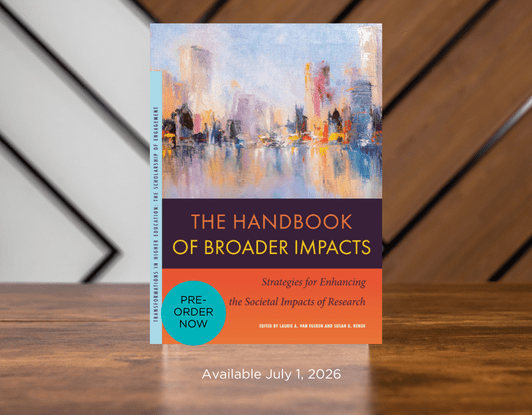
The Handbook of Broader Impacts (pre-order; available July 1, 2026) is an essential resource for researchers, practitioners, administrators, policymakers, and anyone interested in the societal benefits of research. You will learn how to turn research into real-world benefit through policy, practical tools, and proven models you can use now. Explore frameworks, examples, and initiatives shaping impact today.
If you are starting your proposal, ARIS recommends using:
- Broader Impacts (BI) Wizard that is a step-by-step tool that will help you develop an outline of the key points that should be included in your NSF proposal (or in other public/private proposals that require broader impact statements).
- Broader Impacts Guide Sheet [PDF] is a two-page printable document, instead of the BI Wizard, that will help you develop an outline of the key points that should be included in your NSF proposal (or in other public/private proposals that require broader impact statements).
Once you have the initial draft of a statement or if you are evaluating proposals, ARIS recommends using:
- Broader Impacts Guiding Principles document [PDF] that:
- proposal writers can use to think and articulate how broader impacts will be incorporated and begin to develop an impact identity that matches with their career goals. With an easy-to-use checklist, the document will also help identify any gaps in the broader impacts statement against what the NSF criteria requires.
- reviewers and program managers can use to grade and evaluate broader impacts plans in proposals.
- Broader Impacts Plan Rubric that:
- proposal writers can use this to help write stronger BI statements that ultimately match with their own career goals to create an impact identity.
- reviewers and program managers can use to assess the rigor and quality of a BI plan.
For those who want more information about broader impacts, ARIS offers:
- ARIS’ Evolution of Broader Impacts [PDF] was the follow-up from the NABI 2018 analysis that examined the state of Broader Impacts and recommended areas for enhancement. This document was released in August 2023.
- The Current State of Broader Impacts [PDF] was the first document from the Broader Impacts community about the state of Broader Impacts when the organization was known as NABI. This document was released in January 2018.
The U.S. NSF also offers Broader Impacts resources that may help: